FILM 2323: WHO FRAMED ROGER RABBIT (1988)
FILM 2323: WHO FRAMED ROGER RABBIT (1988)
TRIVIA: With an estimated production budget of $70 million, this was the most expensive film produced in the 1980s, and had the longest on-screen credits for a film.
This movie is the first (and only, as of 2020) time cartoon characters from Walt Disneyand Warner Brothers have appeared together on-screen.
Bob Hoskins said that, for two weeks after seeing the movie, his young son wouldn't talk to him. When finally asked why, his son said he couldn't believe his father would work with cartoon characters such as Bugs Bunny and not let him meet them.
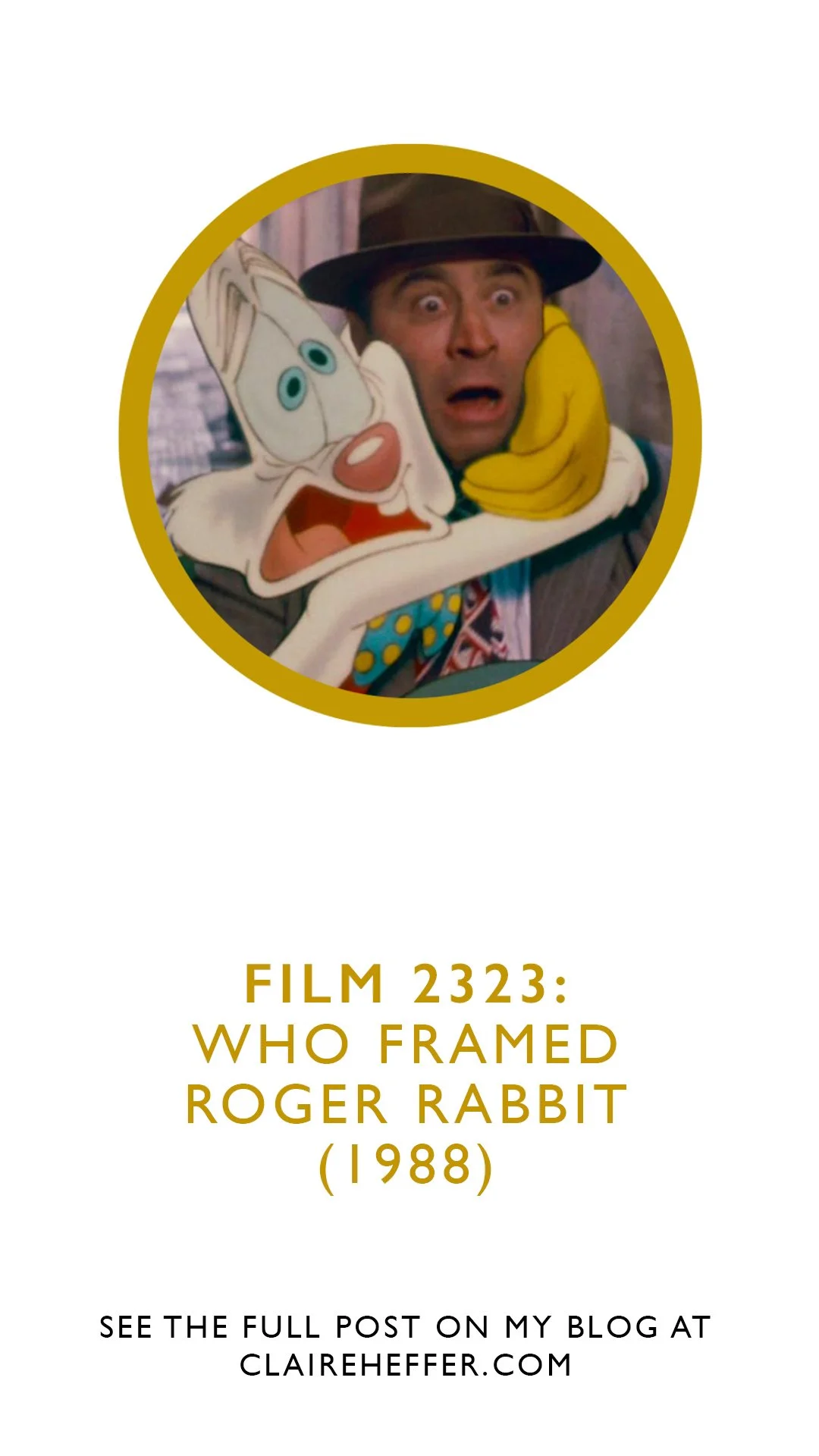
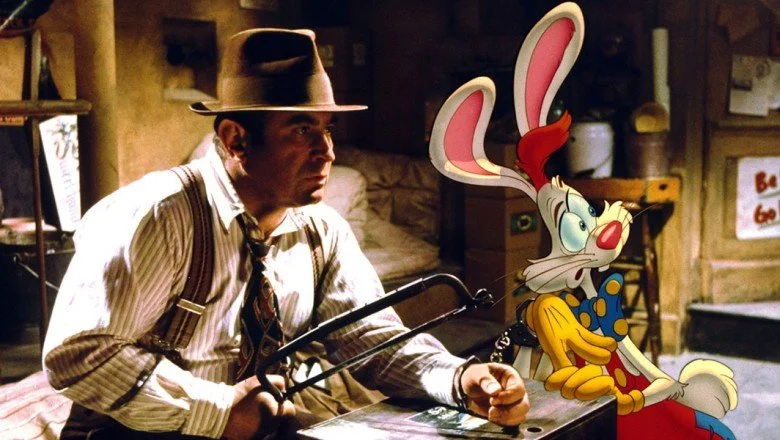
When Eddie takes Roger Rabbit into the back room at the bar where Dolores works to cut apart the handcuffs, the lamp from the ceiling is bumped and swinging. Lots of extra work was needed to make the shadows match between the actual room shots and the animation. Today, "Bump the Lamp" is a term used by many Disney employees to refer to going that extra mile on an effect just to make it a little more special, even though most audience members will never notice it.
Since the movie was being made by Disney's Touchstone Pictures, Warner Brothers would only allow use of their biggest toon stars, Bugs Bunny and Daffy Duck, if they got as much screentime as Mickey Mouse and Donald Duck. For that reason, they were always in pairs, such as the piano battle between Daffy and Donald and the parachute scene with Bugs and Mickey. This was continued with Porky Pig and Tinkerbell at the end of the movie.
On the Special Edition DVD, Robert Zemeckis recounts that he had stated in a newspaper interview that Bill Murray was his and executive producer Steven Spielberg's original choice for the role of Eddie Valiant, but neither could get in contact with him in time. Bill Murray, in turn, has stated that when he read the interview, he was in a public place, but he still screamed his lungs out, because he would have definitely accepted the role.
Wallace Shawn was considered for the role of Eddie Valiant.
John Goodman, Joe Pesci and Tim Allen were considered for the role of Eddie Valiant.
Although the film's title is a question, no question mark appears in the title, as this is considered bad luck in the industry.
Robert Zemeckis keeps the stop-motion model of the flattened Judge Doom in his office.
Robert Zemeckis used the "Benny the Cab" go-kart during the production of Back to the Future Part III (1990). In some shots for the scene where Marty is dragged by the horse, Michael J. Fox was actually being dragged by the Benny go-kart.
Road Runner and Wile E. Coyote, who briefly appear in the final "roll call" shot, actually had not been created at the time the movie was set (1947). The characters were given a small cameo anyway at the insistence of Steven Spielberg.
The tunnel through which Valiant drives to reach Toon Town is the same tunnel used for Back to the Future Part II (1989)'s hoverboard versus Biff's Ford chase. Robert Zemeckis also directed that film in which Christopher Lloyd also starred, plus Who Framed Roger Rabbit (1988) composer Alan Silvestri also composed the music.
Joel Silver's cameo as the director of the Baby Herman cartoon was a prank on Disney chief Michael Eisner by Robert Zemeckis and Steven Spielberg. Eisner and Silver hated each other from their days at Paramount Pictures in the early 1980s, particularly after the difficulties involved in making 48 Hrs. (1982). Silver shaved off his beard, paid his own expenses, and kept his name out of all initial cast sheets. When Eisner was told after the movie was complete who was playing the director, (Silver was nearly unrecognizable), he reportedly shrugged and said "he was pretty good."
To convince the Disney and Amblin executives that they could make the movie, the filmmakers shot a short test involving Roger bumping into some crates in an alley and then getting picked up by a version of Valiant played by Joe Pantoliano (this test can be seen in the Behind the Ears: The True Story of Roger Rabbit (2003) documentary on the Vista Series DVD). After viewing the test, several of the Disney executives were convinced they had seen a traditional "man-in-a-suit" gag with added animation. They couldn't believe it when they were told that it was one hundred percent animation.
Judge Doom was originally going to have an animated pet vulture that sat on his shoulder, but that idea was dropped in the interest of saving time. However, the vulture later resurfaced with Judge Doom, when a bendable action figure was produced.
Ideas for a sequel were tossed around for years, but none ever materialized. One story idea that came close to being produced was 'Who Discovered Roger Rabbit', and it would have been in the 1950s' style of filmmaking. Robert Zemeckis has repeatedly stated that a script exists, describing it as "more a continuation than a sequel", but the rights reside with Disney, who are not interested in making it since "there's no princess in it".
The movie's line "I'm not bad. I'm just drawn that way." was voted as the #83 of "The 100 Greatest Movie Lines" by Premiere in 2007.
Included among the "1001 Movies You Must See Before You Die", edited by Steven Schneider.
I’m making my way through the book "1001 Movies You Must See Before You Die", edited by Steven Schneider. See my blog post about my copy of the book here…
You can buy an updated version (which I will get after I’ve made my way through this edition) here…
I really hope you can come on this journey with me – if you do I’d love to know which films you’ve enjoyed the most!
ONE SENTENCE REVIEW: Finding out a little about the effects in this film made me enjoy it even more, a fun time despite the fact that (possibly a controversial opinion) I’m not a fan of Roger himself.
Watch this here…
This is featured on the podcast Blank Check episode Who Framed Roger Rabbit With Mike Mitchell & Nick Wiger
IF YOU LIKE THIS POST YOU MIGHT ALSO LIKE…