FILM 2275: MOTHERLESS BROOKLYN (2019)
FILM 2275: MOTHERLESS BROOKLYN (2019)
TRIVIA: Edward Norton met and consulted many members of the Tourette's Association of America to prepare for the role. The film has received approval from the organization as well.
According to writer, director and actor Edward Norton, the principal major stars all worked for free on this, his second directorial outing.
Although Jonathan Lethem's novel is set in 1999, the year it was published, Edward Norton wrote the screenplay to be set in 1957, believing the novel's characters and dialogue were better suited to a noir film, and because he'd always wanted to make a period film.
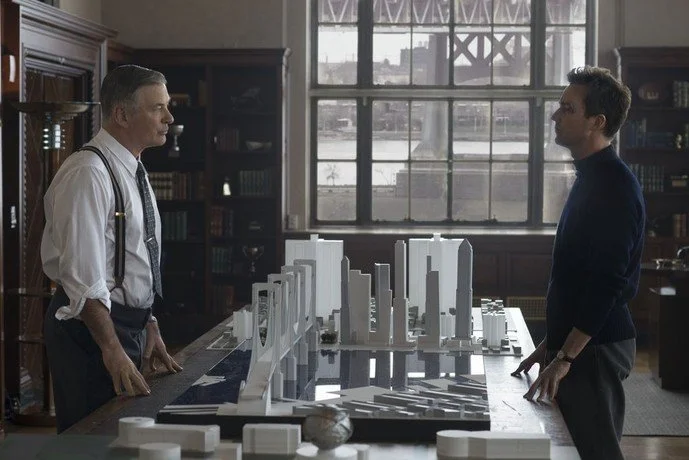
Alec Baldwin's character Moses Randolph is based on real life city planner Robert Moses. Moses is largely to blame for the Brooklyn Dodgers leaving Brooklyn for Los Angeles. The Dodgers leaving Brooklyn is mentioned once in the movie on the radio and hinted at later when Randolph mentions a baseball team playing where he says.
Robert Moses did not just have three simultaneous city commissioner jobs but at one time or another he had more than a dozen. During the Great Depression, he operated largely on WPA grants and this, along with massive revenues from toll roads he had built, allowed him to be largely immune from powers that controlled municipal purse strings. Being what appeared to be a sociopath, he did what he wanted without regard for the suffering it caused and was answerable to no one.
He was also a racist. Moses, who was an enthusiastic swimmer, is depicted swimming in a public pool. He was responsible for building a massive number of swimming pools in New York and, according to biographer Robert Caro, he kept them a few degrees colder because he had the belief that black people disliked swimming in cold water. Also, his emphasis on roads over subways led to the suburban growth of Long Island and other places, while pouring money into tolls, creating a massive conflict of interest. According to Caro, he designed overpasses for the parkways to be low so that lower income people could not ride buses into the city, thereby limiting racial integration in the suburbs. He was also strongly opposed to allowing black veterans to move in to the veterans' Stuyvesant Town housing complex. His method for turning poor neighborhoods into slums is accurately depicted in the film.
Due to failed, unpopular project initiatives (such as plans to build a parking lot in Central Park for Tavern on the Green), his opposition to free Shakespeare in the Park, his razing of Pennsylvania Station, and his bullheaded unwillingness to accept international standards when designing the 1964 World's Fair (which was largely a failure) he had lost most of his power by the mid 1960s.
One NYC firefighter was killed and two others injured on the set of this movie when fire broke out in the building used for the night club on March 22, 2018.
Edward Norton was such a fan of Gugu Mbatha-Raw's acting that he wrote the part of Laura Rose (a character not present in the book) specifically for her.
A textbook example of the "Doris Day parking spot" trope occurs when Lionel and Laura pull up to the King Rooster and park right in front, even though the club is packed.
Edward Norton's second turn in the director's chair after directing Keeping The Faith (2000).
This movie was addressed during Comedy Central's "Roast of Bruce Willis". During Edward Norton's speech he gave a heartfelt thank you to Bruce.
A newspaper headline identifies "The Lindbergh Palace Hotel" as the setting for the subsequent scene, a fictional hotel also found in The Royal Tenenbaums. Clearly, this is a sly tribute to the many Wes Anderson movie credits of most of the principal actors.
ONE SENTENCE REVIEW: Very different from the book, not all to its detriment, an okay film but not great.
Watch this here…
IF YOU LIKE THIS POST YOU MIGHT ALSO LIKE…